The bottom line: Maximum solar savings come from three habits — matching consumption to production (run heavy loads during sunlight), pairing with battery storage for evening offset, and adding an OEM electricity plan for the residual. Combined, these can push savings from typical 70–85% to 90–95%. For a S$400/month landed home bill, that is the difference between S$60 and S$25 monthly — and S$10,000+ extra over 25 years.
Introduction: The Golden Era of Solar Savings in Singapore
Singapore homeowners have never had a better opportunity to slash their electricity bills. With Q1 2026 electricity tariffs at S$0.3148/kWh and solar system costs at historic lows, a well-designed solar installation now pays for itself in just 3–4 years — then delivers free electricity for the remaining 21–22 years of its lifespan.
But simply installing solar panels isn't enough. How you use your solar energy matters just as much as how much you generate. This comprehensive guide reveals the strategies that separate homeowners who save S$1,500 per year from those who save S$4,000+ per year with solar — using the same amount of sunshine.
Whether you're considering solar for the first time or looking to squeeze more value from an existing installation, this guide covers every angle: tariff analysis, consumption-based savings scenarios, smart scheduling techniques, net metering optimisation, battery storage strategies, and long-term projections that account for rising electricity costs.
Singapore Electricity Tariffs: A Historical Perspective and 2026 Analysis
Understanding where electricity prices have been — and where they're headed — is essential for calculating your solar savings accurately.
Historical Tariff Trend
Singapore's regulated electricity tariffs have shown a clear upward trajectory over the past decade, driven by global energy prices, carbon taxation, and infrastructure investments:
| Year / Quarter | Tariff (S$/kWh) | Year-on-Year Change |
|---|---|---|
| 2019 Average | S$0.2424 | — |
| 2020 Average | S$0.2282 | -5.9% |
| 2021 Average | S$0.2444 | +7.1% |
| 2022 Q3 (Peak) | S$0.3295 | +34.8% |
| 2023 Average | S$0.3178 | — |
| 2024 Average | S$0.3080 | -3.1% |
| 2025 Average | S$0.3105 | +0.8% |
| 2026 Q1 | S$0.3148 | +1.4% |
What This Means for Your Savings
The long-term trend is clear: electricity costs are rising. Even conservative projections suggest 3% annual tariff increases over the next decade, driven by carbon tax increases (Singapore's carbon tax is set to reach S$50/tonne by 2026 and S$80/tonne by 2030), infrastructure upgrades, and global energy market dynamics.
Every kWh your solar system generates is a kWh you don't buy from the grid at these rising prices. This creates a compounding savings effect: your solar panels produce roughly the same amount of energy each year, but the value of that energy increases as tariffs rise. For a detailed breakdown of solar panel costs, see our Solar Panel Cost Singapore 2026 guide.
Monthly Savings Scenarios: How Much Can You Actually Save?
Your solar savings depend primarily on two factors: how much electricity you consume and how much solar capacity your roof can accommodate. Here's a realistic breakdown for different household sizes:
| Monthly Consumption | Typical Home Type | Recommended System | System Cost (Sunollo) | Monthly Savings (Year 1) | Annual Savings (Year 1) | Payback Period |
|---|---|---|---|---|---|---|
| 300 kWh | Small HDB / Apartment | 3 kWp | S$3,000–3,600 | S$79–94 | S$945–1,134 | 3.2–3.8 years |
| 500 kWh | Large HDB / Small Condo | 5 kWp | S$5,000–6,000 | S$131–158 | S$1,575–1,890 | 3.0–3.8 years |
| 800 kWh | Landed Terrace / Semi-D | 8 kWp | S$8,000–9,600 | S$210–252 | S$2,519–3,024 | 3.0–3.8 years |
| 1,200 kWh | Detached / Bungalow | 12 kWp | S$12,000–14,400 | S$315–378 | S$3,780–4,535 | 3.0–3.8 years |
| 1,500+ kWh | Large Bungalow / GCB | 15–20 kWp | S$15,000–24,000 | S$394–630 | S$4,725–7,560 | 3.0–3.8 years |
Note: Savings calculated at S$0.3148/kWh (Q1 2026 tariff). Sunollo systems priced at S$1,000–S$1,200/kWp fully installed, including panel-level optimisers and SunolloCare 25-year programme. Actual savings may vary based on roof orientation, shading, and consumption patterns.
Why Sunollo Systems Save More
These savings figures reflect systems with panel-level optimisers included as standard. Compared to basic string inverter installations, Sunollo systems typically produce 5–25% more energy due to per-panel optimisation. This translates directly into higher savings — an additional S$100–500 per year depending on system size and shading conditions.
Smart Scheduling: Run High-Energy Appliances During Peak Solar Hours
One of the simplest yet most effective ways to maximise your solar savings is to shift your energy-intensive activities to peak solar production hours: 10:00 AM to 3:00 PM.
Why Timing Matters
Under Singapore's net metering scheme (Enhanced Central Intermediary Scheme or ECIS), excess solar energy is exported to the grid and credited against your bill. While this means no energy is wasted, self-consumed solar energy is more valuable than exported energy because:
- You avoid the full retail tariff (S$0.3148/kWh) for every kWh consumed directly
- Export credits are applied at a slightly lower rate after accounting for grid charges
- Self-consumption reduces your peak demand charges
Appliances to Schedule During 10 AM – 3 PM
- Washing machine and dryer: A typical wash cycle uses 0.5–2.0 kWh. Run your laundry during midday when solar production peaks.
- Dishwasher: Uses 1.0–1.8 kWh per cycle. Set the delay timer for a noon start.
- Pool pump: Pool pumps are major energy consumers at 1–2 kW continuous. Schedule the daily filtration cycle during peak solar hours to offset this large load entirely.
- Electric vehicle charging: If you have a home EV charger, daytime charging at 7 kW can consume your entire solar production — maximising self-consumption.
- Water heater: If you use an electric water heater (heat pump or element), schedule it to run during solar peak to pre-heat water for evening use.
- Robot vacuum: Schedule your daily clean for midday.
Practical Tips for Smart Scheduling
- Use smart plugs and timers to automate scheduling — no need to remember daily
- Many modern appliances have built-in delay start features — use them
- Consider a smart home energy management system that automatically shifts loads to periods of high solar production
- Monitor your system via the SunolloCare app to understand your daily production pattern and adjust schedules accordingly
Net Metering Optimisation Strategies
Singapore's net metering scheme (ECIS) is a powerful tool for solar homeowners, but understanding how to optimise it can significantly increase your returns.
How Net Metering Works in Singapore
Under the ECIS, excess solar energy is exported to the grid through your SP Group meter. This energy is sold to the wholesale electricity market, and the revenue is credited to your SP bill. The process is automatic — no additional equipment or registration is needed beyond your solar installation's EMA approval.
Strategies to Maximise Net Metering Value
- Right-size your system: A system that's too large relative to your consumption will export more energy at lower wholesale rates. A system matched to your daytime consumption maximises the higher-value self-consumption.
- Prioritise self-consumption: Use the smart scheduling techniques above to consume as much of your own solar energy as possible during the day.
- Monitor export vs self-consumption ratios: Track these metrics through your monitoring system (SunolloCare provides this data automatically). Aim for a self-consumption ratio above 40–50%.
- Consider a battery: A battery can store excess daytime production for evening use, dramatically increasing self-consumption from ~30% to 70–80% in typical homes.
Wondering how solar stacks up against switching to an electricity retailer? Our Solar vs Electricity Retailers comparison breaks down the numbers.
Battery Storage: Capturing Evening Savings
Without a battery, your solar panels sit idle from sunset to sunrise — exactly when most families use the most electricity. Battery storage bridges this gap by storing excess daytime solar production for evening and nighttime use.
How Batteries Increase Your Savings
A typical Singapore home without a battery self-consumes about 25–35% of its solar production, exporting the rest. With a properly sized battery, self-consumption can increase to 70–85%. Here's the impact:
| Scenario | Self-Consumption Rate | Grid Import Reduction | Additional Annual Savings |
|---|---|---|---|
| Solar only (no battery) | 25–35% | 25–35% | Baseline |
| Solar + 5 kWh battery | 50–65% | 50–65% | +S$300–500 |
| Solar + 10 kWh battery | 65–80% | 65–80% | +S$500–800 |
| Solar + 13.5 kWh battery | 75–85% | 75–85% | +S$600–1,000 |
Sunollo offers battery solutions ranging from S$5,000 to S$12,000 for standard homes, with options from leading brands including Tesla Powerwall, BYD, Huawei LUNA, and Enphase. We recommend batteries particularly for households with high evening consumption or those seeking energy independence.
Seasonal Variation: How Singapore's Monsoons Affect Solar Production
While Singapore enjoys abundant sunshine year-round (averaging 4.5–5.0 peak sun hours daily), there are meaningful seasonal variations that affect your monthly solar production.
Northeast Monsoon (December – March)
This is Singapore's wettest period, with more cloud cover and rainfall. Solar production typically drops to 80–90% of peak levels. However, temperatures are also slightly lower, which improves panel efficiency somewhat, partially offsetting the reduced irradiance.
Southwest Monsoon (June – September)
Drier conditions bring more consistent sunshine. Solar production reaches its peak during this period, with some months achieving 110–115% of the annual average.
Inter-Monsoon Periods (April–May, October–November)
These transitional periods feature afternoon thunderstorms but generally good morning sunshine. Production is typically near the annual average.
Monthly Production Pattern
| Month | Relative Production | Typical Conditions |
|---|---|---|
| January | 85–90% | Northeast monsoon, cloudy |
| February | 95–105% | Transitional, improving |
| March | 100–110% | Good sunshine, lower humidity |
| April | 95–105% | Inter-monsoon, afternoon storms |
| May | 95–100% | Inter-monsoon, afternoon storms |
| June | 100–110% | Southwest monsoon begins, dry |
| July | 105–115% | Peak production month |
| August | 105–115% | Peak production month |
| September | 100–110% | Good production, dry |
| October | 90–100% | Inter-monsoon, variable |
| November | 85–95% | Northeast monsoon approaching |
| December | 80–90% | Northeast monsoon, wettest month |
Sunollo's SunolloCare monitoring tracks your system's production against these seasonal benchmarks, automatically alerting you if performance falls below expected levels for any given month. This ensures issues like dirty panels or equipment faults are caught quickly, before they significantly impact your savings.
25-Year Savings Projection: The Long-Term Value of Solar
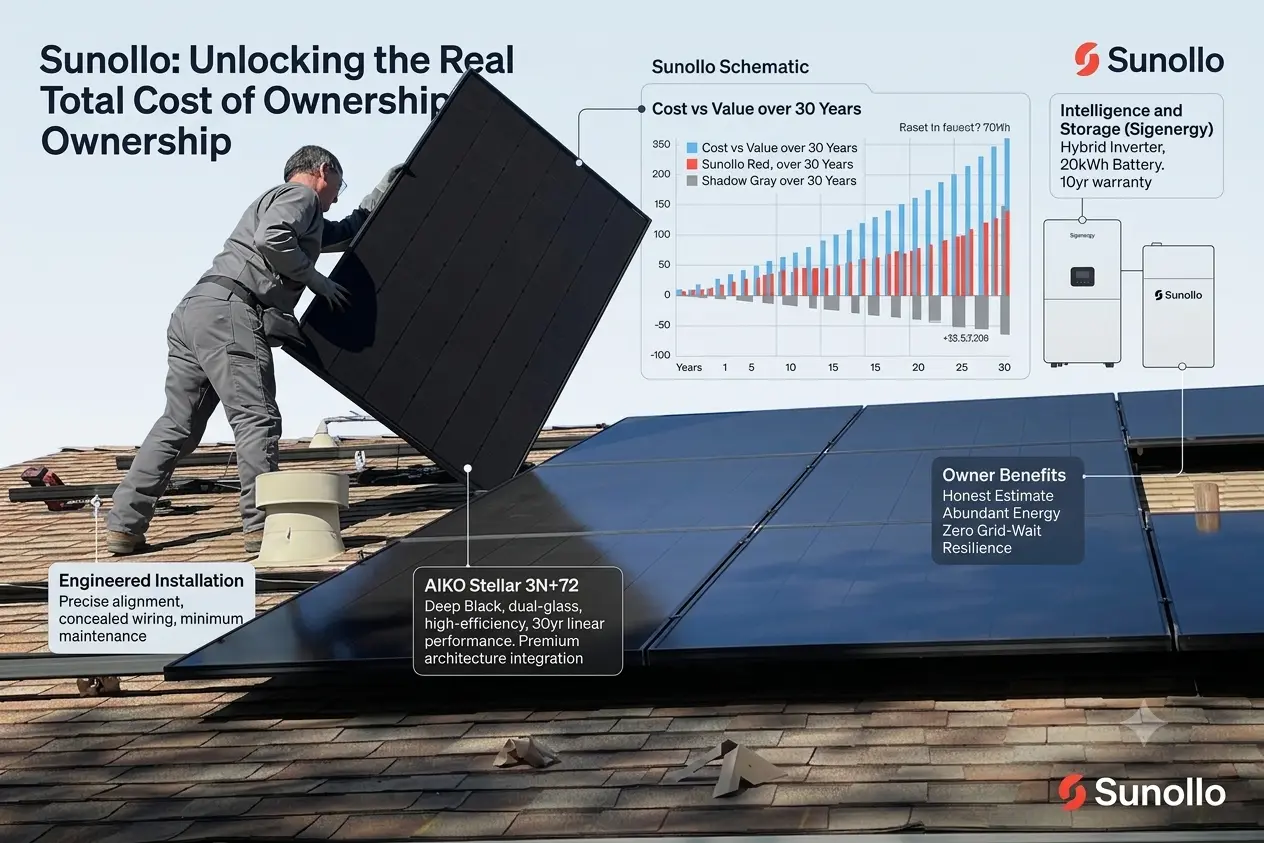
Solar panels last 25–30+ years, and the true value of your investment becomes clear when you project savings over this full lifespan. Here's what a typical 10 kWp Sunollo system delivers over 25 years, accounting for 3% annual electricity tariff increases and 0.4% annual panel degradation:
| Year | Tariff (S$/kWh) | Annual Production (kWh) | Annual Savings | Cumulative Savings |
|---|---|---|---|---|
| 1 | S$0.3148 | 13,500 | S$4,250 | S$4,250 |
| 2 | S$0.3242 | 13,446 | S$4,360 | S$8,610 |
| 3 | S$0.3340 | 13,392 | S$4,473 | S$13,083 |
| 5 | S$0.3543 | 13,285 | S$4,706 | S$22,189 |
| 10 | S$0.4108 | 13,021 | S$5,350 | S$47,120 |
| 15 | S$0.4764 | 12,764 | S$6,079 | S$75,745 |
| 20 | S$0.5523 | 12,511 | S$6,908 | S$108,500 |
| 25 | S$0.6403 | 12,263 | S$7,852 | S$146,300 |
Key takeaways from this projection:
- A 10 kWp Sunollo system costing S$10,000–S$12,000 delivers approximately S$146,300 in cumulative savings over 25 years
- That's a 25-year ROI of 580–660%
- The system pays for itself in 3–4 years, then generates free savings for 21–22 more years
- Annual savings increase over time as electricity tariffs rise — by year 25, you're saving nearly twice what you saved in year 1
- Even accounting for panel degradation (0.4%/year with quality panels), the rising tariff more than compensates
These projections assume conservative 3% annual tariff increases. If tariffs rise faster (as they have historically during energy crises), your returns will be even higher.
SunolloCare: Monitoring for Maximum Performance
A solar system is only as good as its ongoing performance. Sunollo's SunolloCare programme ensures your system delivers maximum savings throughout its 25-year lifespan.
What SunolloCare Includes
- Real-time monitoring: Every panel is monitored individually through panel-level optimisers. If any panel underperforms, you and our team are alerted immediately.
- Performance analytics: Monthly and annual performance reports comparing actual production against expected output, accounting for weather and seasonal factors.
- Proactive maintenance: Scheduled cleaning and inspection visits to keep your panels operating at peak efficiency. Dirty panels can lose 5–15% of their output — regular cleaning prevents this.
- Performance guarantee: If your system underperforms its guaranteed production targets, Sunollo takes responsibility and remedies the issue at no cost to you.
- Full system insurance: Comprehensive coverage for panels, inverters, optimisers, wiring, and mounting — protecting your investment against weather damage, equipment failure, and other risks.
- Priority support: Dedicated support team available for troubleshooting, with rapid response times for any system issues.
SunolloCare is included as standard with every Sunollo installation — it's not an optional add-on. This is our commitment to ensuring your solar investment delivers on its promise, year after year.
Ready to start saving? Explore our Solar for Homes page to see the right system for your household, or check out our comprehensive guide to cutting electricity bills for additional energy-saving strategies.
Frequently Asked Questions
1. How much can I save with solar panels in Singapore in 2026?
At current Q1 2026 tariffs of S$0.3148/kWh, typical savings range from S$945–S$1,134/year for a small 3 kWp system to S$4,725–S$7,560/year for a large 15–20 kWp system. With Sunollo's panel-level optimisers producing 5–25% more energy, your savings are at the higher end of these ranges. Over 25 years, a 10 kWp system saves approximately S$146,300.
2. What is the payback period for solar panels in Singapore?
With Sunollo systems priced at S$1,000–S$1,200/kWp fully installed (including optimisers and SunolloCare), the typical payback period is 3–4 years. This is among the fastest payback periods globally, thanks to Singapore's high electricity tariffs and excellent solar irradiance.
3. Should I run appliances during the day to maximise solar savings?
Yes. Shifting energy-intensive appliances to 10 AM – 3 PM (peak solar hours) increases self-consumption, which is more valuable than exporting to the grid. Key appliances to schedule during solar hours include washing machines, dishwashers, pool pumps, EV chargers, and water heaters. Smart plugs and timers make this effortless.
4. How does net metering work in Singapore?
Under the Enhanced Central Intermediary Scheme (ECIS), excess solar energy is automatically exported to the grid via your SP meter. SP Group sells this energy on the wholesale market and credits the revenue to your electricity bill. No additional equipment is needed — it's part of the standard solar installation approval process.
5. Do solar panels work during Singapore's rainy season?
Yes, solar panels still produce energy on cloudy and rainy days, though at reduced levels. During the northeast monsoon (December–March), production typically drops to 80–90% of peak levels. However, annual production remains highly consistent in Singapore due to its equatorial location. Sunollo's SunolloCare monitoring tracks performance against seasonal benchmarks to ensure your system is always performing as expected.
6. Is a battery worth it for my solar system?
Batteries (S$5,000–S$12,000 for standard homes) increase self-consumption from ~30% to 70–85%, adding S$300–S$1,000 in additional annual savings. They're particularly valuable for homes with high evening consumption or those wanting backup power. For pure financial returns, solar panels alone deliver excellent ROI — batteries add resilience and independence.
7. Will electricity prices continue to rise in Singapore?
All indicators point to continued increases. Singapore's carbon tax is rising to S$50/tonne in 2026 and S$80/tonne by 2030, directly increasing electricity generation costs. Infrastructure upgrades and global energy market dynamics also contribute to upward pressure. Conservative projections suggest 3% annual increases, making solar an increasingly valuable hedge against rising costs.
8. How does SunolloCare help maximise my savings?
SunolloCare provides 25-year monitoring, maintenance, performance guarantee, and full system insurance. Panel-level monitoring catches issues immediately (a single underperforming panel can reduce system output by 5–15%), while regular cleaning prevents dirt-related losses. The performance guarantee ensures your system meets its production targets — and if it doesn't, Sunollo fixes the issue at no cost. This comprehensive approach ensures you capture the full financial value of your solar investment over its entire lifespan.